
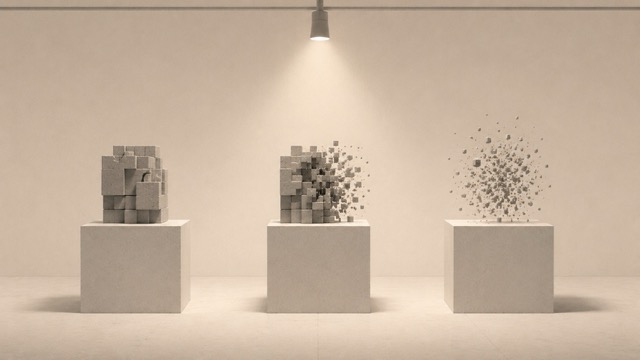
The curatorial problem of generative art
There is a gesture that defines the curator’s craft: deciding what is hung, where, under what light, next to what, and for how long. That gesture presupposes something so obvious it is rarely articulated: that there is an object. A thing that exists there, identical to itself, and which will remain so when the museum closes at night and when it reopens in the morning.
El arte generativo rompe ese presupuesto. Una obra generativa no es un objeto: es un sistema que produce estados. Unsupervised, de Refik Anadol, ocupó el vestíbulo del MoMA durante casi un año generando formas que no se repetían nunca, alimentadas por la colección del museo y por la luz y el movimiento del propio vestíbulo. La ficha de sala la describía como «escultura de datos», con «software personalizado, algoritmo generativo, animación en tiempo real, sonido» y, de manera reveladora, «dimensiones variables». No había una imagen que conservar. Había un proceso en marcha.
This poses a problem that is not technical but curatorial, and which connects directly to something I have been arguing elsewhere in this notebook: that in generative art, what matters is not the final image, but the regime of emergence that produces it. If that is true, then curating generative art cannot be about curating objects. It must be something else. This text is an attempt to name what that is.
1. Exhibiting a process, not an object
The first problem appears in the installation. When what is exhibited is never the same twice, the curator’s classic decisions change in nature.
Duration ceases to be an administrative detail and becomes an aesthetic decision. Is the work exhibited in continuous execution, accepting that no two visitors will witness the same output? Is a version recorded and projected on a loop, sacrificing the work’s generative nature in exchange for control? Each answer defines a distinct work. For Unsupervised, the MoMA opted for continuous execution: the commitment was for the visitor to witness the generation, not its recording.
El espacio deja de ser contenedor y se vuelve parte del sistema. En la muestra Infinite Images: The Art of Algorithms del Toledo Museum of Art, los participantes insistieron en que lo generativo exige «pensar arquitectónicamente»: ajustar altura de paredes, ritmo de sala, iluminación y soportes para que la obra sea comprensible. La artista Sofia Crespo señaló algo que rompe el tópico de que lo digital vive en pantallas: no todas las obras digitales deben quedarse en una pantalla; algunas pueden y deben ocupar espacio físico. La pantalla no es el destino natural de lo generativo; es una de sus posibles materializaciones, y elegirla o rechazarla es una decisión curatorial.
Y la mediación deja de ser un texto explicativo y se vuelve una traducción. Hay una frase de la comisaria Julia Kaganskiy, a propósito de Unsupervised, que condensa el problema: pidió dedicar al montaje de la obra digital «el mismo cuidado y detalle que a un Rubens». No es una boutade. Es la afirmación de que lo generativo merece —y exige— el mismo rigor museográfico que la pintura clásica, precisamente porque su naturaleza procesual lo hace más difícil de presentar, no menos.
Nada de esto es enteramente nuevo. En 1968, Cybernetic Serendipity, comisariada por Jasia Reichardt en el ICA de Londres, ya presentó máquinas que generaban gráficos e interactuaban con el espectador. Reichardt escribió entonces algo que sigue siendo válido: que la muestra exhibía «posibilidades más que logros», y que al público le resultaba indiferente si una pieza la firmaba un artista o un ingeniero, porque eso «no cambia su impacto». El arte generativo lleva más de medio siglo planteando estas preguntas. Lo que ha cambiado es la escala y la urgencia.
2. Conserving what expires
The second problem is more severe, and it is where the difference from traditional art becomes abyssal. An oil painting is conserved through the control of humidity, light, and temperature. How does one conserve a work that depends on software, hardware, or a model that will become obsolete in a decade?
Here the museum faces something for which classical conservation has no tools, and the most lucid response given to this problem does not come from recent generative art, but from two decades of work on media art that almost no one cross-references with current generative practice.
The Variable Media Network, promoted since the late nineties by Jon Ippolito and others at the Guggenheim, proposed a shift in focus that remains the most fertile: to cease defining the work by its physical medium—doomed to obsolescence—and to define it by its behaviour. Is it interactive, reproducible, installed, networked? The central tool is a questionnaire completed by the artist, describing what is essential to their work and what may change. From this, possible strategies emerge: storage, migration to a new format, emulation of the obsolete system with modern software, or reinterpretation of the work from its conceptual description. In the exhibition Seeing Double (Guggenheim, 2004), code-based works were exhibited in their original version and in their emulated version, side by side, to subject this approach to public scrutiny.
Rhizome, associated with the New Museum, extended this logic to net art with its ArtBase and with web archiving tools such as Webrecorder, capable of capturing the experience of online works. And in 2004, major museums—MoMA, Guggenheim, Tate, SFMOMA—launched Matters in Media Art, a joint effort to establish protocols for the acquisition and loan of time-based works.
The revelation lies in the specific cases. When MoMA acquired 33 Questions Per Minute by Rafael Lozano-Hemmer, the artist provided screens, a controller, a computer, software, data, and source code, along with manuals and interviews, and authorised the museum to change the number and size of the screens in the future. He ceded interpretive margin: he stated, in effect, what was essential and what was not. Conversely, when Feng Mengbo delivered Long March: Restart, he provided the hardware but not the source code, stipulating that the work would be preserved by emulating its original environment. Two artists, two opposing decisions regarding what constitutes the integrity of their work. And that decision—not the conservator's—is what determines how it will be preserved.
Herein lies the consequence of interest. In generative art, to conserve is not to preserve an object: it is to preserve the capacity to re-execute a process. As this capacity relies upon infrastructures that expire, conservation becomes inseparable from a question we would normally consider antecedent: what is essential to this work? The museum does not possess the answer. The artist does, and the museum may only act if the artist has made it explicit. The conservation of the generative necessitates documenting the regime of emergence—the rules, the immutable, that which may vary—for it is the only element that shall survive the medium.
3. The gap, which is part of the argument
At this juncture, one must address that which does not exist, for the void is as significant as that which is present.
There exists no systematic curatorial literature regarding the installation of generative art. There are press releases, interviews, and occasional catalogues; there are no manuals or comparative studies that synthesise how various institutions resolve duration, labelling, or mediation. Each museum improvises, and experience remains unaccumulated.
Furthermore, there exist no published cases detailing how a museum updates or reconstructs the code, libraries, or models of a contemporary generative work once they expire. Media art protocols exist, yet their application to generative AI art—which relies upon particularly fragile and opaque models—remains largely unwritten.
And there exists no research, save for anecdotal observations, regarding how the public receives a generative work within the gallery. We know, through an observation by Kaganskiy, that interactive elements function as a hook for younger audiences. We know almost nothing else: there are no studies comparing the visitor experience of a work that changes continuously against that of a fixed object. The intersection between aesthetic reception and generative art in the gallery remains virtually unexplored—and it is, not coincidentally, one of the questions I have been pursuing in another section of this notebook.
These three lacunae are not a defect of this reflection: they are its justification. They indicate that the curation of the generative is a territory in formation, where decisions are made without a consolidated body of practice behind them. Those who work within it do not apply established knowledge: they are inventing it.
4. Curating an emergency regime
I resume the thread from the beginning. If a generative work is not an object but a system that produces states, then the three dimensions of the profession shift simultaneously.
Exhibiting ceases to be the placement of an object and becomes the provision of conditions for a process to occur before the public: deciding its duration, its space, its rhythm, whilst acknowledging that no two individuals will witness exactly the same outcome. Conserving ceases to be the preservation of a thing and becomes the guarantee that the process may be re-executed, documenting what is essential within it so that it may survive the expiration of its medium. And mediating ceases to be the explanation of an image and becomes the translation of a system: rendering it comprehensible that what the visitor observes is one of the infinite possible outputs of a generative machine, rather than a chosen image.
The three operations share a common denominator. The curator of the generative does not curate objects: they curate regimes of emergence. Their material is not the finished work, but the system that generates it and the conditions under which that system unfolds before an observer. It is a shift of the same order as that which generative artistic practice itself imposed decades ago, when the artist ceased to create the image to instead design the process that creates it. Curation now arrives at that same threshold.
This is not an incidental difficulty that will be resolved by superior technology. It is a shift in the nature of the profession. And it must be addressed as such: not as the challenge of exhibiting screens, but as the question of what it means to curate, display, and transmit something that, by definition, is never finished.
A note from Málaga
I write this from a city that has made museums a cornerstone of its identity. Málaga possesses a remarkable density of institutions and has begun to incorporate the digital: the Centre Pompidou has addressed AI, augmented reality, and blockchain from an educational perspective; La Térmica inaugurated a line of immersive digital art with Lux; and the CM Málaga forum has brought together international professionals—including Christiane Paul, curator at the Whitney and a leading voice in digital art—to discuss art and digital creativity as drivers of cultural transformation.
However, one must be candid: in recent programming, I have not encountered a specific and sustained commitment to generative art, nor a strategic framework that articulates art and technology beyond sporadic events and programmes. The interest exists; a distinct curatorial line, however, does not. Therein lies an opportunity that extends beyond Málaga. The curation of generative art remains to be established in almost every quarter. It would be remarkable for a city that has already committed to museums to take the step of committing, with discernment, to the art form that most compels a reconsideration of what a museum is.
That is the debate I wish to initiate. This notebook remains, as always, open to anyone who wishes to contribute—whether from the fields of curation, media conservation, generative practice, or museum management.
Sources
The Museum of Modern Art. Refik Anadol: Unsupervised (2022–2023). Exhibition record and gallery materials. https://www.moma.org/calendar/exhibitions/5535
Toledo Museum of Art. Infinite Images: The Art of Algorithms (2025). Exhibition documentation and curatorial statements (Julia Kaganskiy, Emily Xie, Sofia Crespo).
Reichardt, J. (Ed.). (1968). Cybernetic Serendipity: The Computer and the Arts. Institute of Contemporary Arts, London. Exhibition catalogue.
Variable Media Network / Guggenheim Museum. The Variable Media Approach and Variable Media Questionnaire. (Depocas, A., Ippolito, J., & Jones, C., eds., Permanence Through Change: The Variable Media Approach, 2003). http://www.variablemedia.net
Guggenheim Museum. Seeing Double: Emulation in Theory and Practice (2004). Exhibition and documentation.
Rhizome. ArtBase and web archiving tools (Webrecorder / Conifer). https://rhizome.org
MoMA, Guggenheim, Tate & SFMOMA. Matters in Media Art (2004; ed. for collections, 2013). http://www.tate.org.uk/about-us/projects/matters-media-art
Wharton, G. The Challenges of Conserving Contemporary Art and documentation of MoMA digital acquisitions (33 Questions Per Minute, Lozano-Hemmer, 2000; Long March: Restart, Feng Mengbo, 2009).
La Térmica (Diputación de Málaga). Lux programme of immersive digital art (2023–2024). https://www.latermicamalaga.com
Centre Pompidou Málaga. Programming and educational activities regarding art and technology.
CM Málaga – Culture & Museums Tech Forum (FYCMA, 2023–2024). Forum documentation.
Esteban Ruiz, J. A. Processes Without Meaning. Public notebook at juanesteban.art, 2026.
Esteban Ruiz, J. A. Art as Structural Surplus: Toward a Relational Ontology Beyond Human Authorship (V2.3). PhilArchive and Zenodo, 2026.