
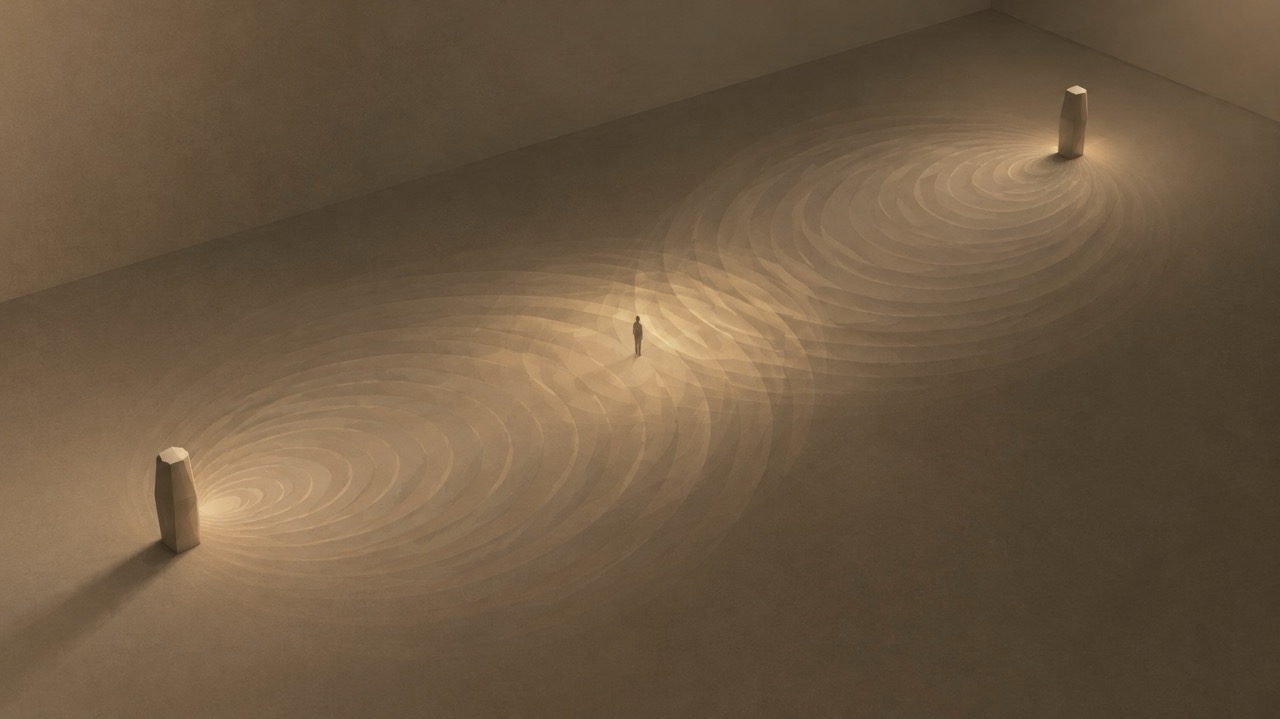
In room 105 of the Guggenheim Museum Bilbao, there are no objects or images. From 9 October 2026 to 21 February 2027, Steve McQueen presents 66–76–26: two voices isolated from their accompaniment, situated at opposite ends of a dark room. Nina Simone sings Wild Is the Wind in the 1966 recording. David Bowie does so in the 1976 version. The final number in the title corresponds to 2026, the year in which these interpretations meet in Bilbao.
The song was composed by Dimitri Tiomkin and Ned Washington for the 1957 film Wild Is the Wind. The recordings were not born to dialogue. McQueen removes the instrumentation and constructs a spatial relationship between them. According to the museum, he had been thinking about reuniting them for some thirty years after hearing Bowie's version first and, shortly thereafter, Simone's.
The work was conceived for the museum with curator Lekha Hileman. McQueen has linked the radical desire of both interpretations to love and to two difficult historical moments. The institutional catalogue entry situates Simone's recording within the American civil rights movement and Bowie's in a period of addiction and personal collapse. This contextual reading belongs to the exhibition's curatorial framework; the experience is not exhausted by these biographies.
I have not visited the installation. I write based on museum documentation and published chronicles. In a work whose argument depends on being inside, that distance limits what can be asserted.
A work without an image, disseminated through images
Most of the public life of an exhibition occurs outside the room: institutional photographs, reports, videos and visitor posts. 66–76–26 resists this regime. A photograph registers darkness, architecture and perhaps loudspeakers. It does not contain the separation between the voices nor the change produced by the movement of the listener.
The museum formulates it clearly: "there is nothing to photograph". To communicate this, however, it requires images of the room, of McQueen, of Simone, and of Bowie. It is not a contradiction that can be avoided. It shows that the circulation of a work can rely on representations that are not equivalent to it.
Distance also affects this text. I can describe the apparatus and examine its consequences. I cannot reconstruct the acoustic balance, the reverberation, the volume, the listening time of each visitor, or the sensation of entering from another gallery. A critique from a distance must declare what it knows through documentation and what would require presence.
The lack of an image does not produce purity. The room remains a designed, illuminated, and regulated architecture. There are technical systems, sound levels, entrances, routes, and schedules. The apparently immaterial experience depends on a precise material infrastructure.
The third voice is a position
The Spanish version of the museum's catalogue entry calls the visitor "the third voice"; the English speaks of "the other voice". Both formulas indicate that the public is not limited to receiving a finished duet.
If the sound sources are at opposite ends, each position creates a distinct mix. Near Simone, Bowie recedes; near Bowie, Simone becomes distance. In the centre, the voices overlap, but that zone does not necessarily produce a stable union. The interpretations retain their own rhythm, breath, phrasing, and temporalities.
The visitor does not add vocal sound, save for the noise of their body and their breathing. They add a listening point. The third voice is not a recorded track: it is the variable relationship that movement composes between two fixed registers.
This distinguishes the installation from a domestic comparison using headphones. McQueen does not incorporate a note or alter the history of the recordings. He changes the conditions under which they are heard. Two interpretations that could be played successively now occupy a common space. The authorship of the installation resides in that reorganisation, not in appropriating the songs as indifferent material.
The work requires time. Entering, recognising a voice, walking, losing a part, and finding another. A brief recording made with a mobile phone fixes a specific mix and eliminates spatial choice. It can document that there was sound; it is a poor substitute for the experience it seeks to preserve.
Darkness, attention, and authority
The dim light reduces visual stimuli and directs attention. It also makes one more conscious of one's own body: footsteps, distance, the presence of other people. The museum describes the room as stripped of object and image, although the space is not neutral. Darkening is a scenographic and acoustic decision.
The apparatus produces authority. Isolating well-known voices in a museum, within an empty enclosure and with time for contemplation, separates them from everyday listening. The song ceases to function as background and becomes an event. The institution does not create the intensity of the interpretations, but it organises a situation in which to attend to them differently.
This transformation may be accused of solemnising popular materials through the museum. It can also be understood as a redistribution of attention: removing instruments and images so that breath, breaks, and differences between both voices occupy the foreground. Without having been in the room, I cannot decide if the installation sustains that attention or if the apparatus over-explains songs that already contained it.
This tension is significant, as a work of listening cannot remain free from mediation. The selection of recordings, the separation of channels, the architecture and the curatorial narrative all guide the experience. The absence of an image is not an absence of montage.
What a museum preserves
The two recordings can be archived. So too can the audio file that isolates the voices, provided the licence and agreement permit it. Loudspeakers, levels, orientation, dimensions, lighting, reverberation and duration can all be documented. No single piece in isolation constitutes the installation.
Responsible conservation requires identifying which elements are essential and which may change:
- Recordings, version and sound processing.
- Distance and relative position of the sources.
- Darkness and residual light.
- Level, range and directionality of the reproduction.
- Permissible acoustics and adjustments for another room.
- Access, capacity and public circulation.
- Replaceable equipment and criteria for equivalence.
- Artist's instructions for future reinstalments.
The problem has belonged to sound art and installation for decades. Storing the medium is insufficient; one must preserve a behaviour. "When the model disappears" examines a similar difficulty in works connected to external services: the archive may survive while that which executes it changes. In 66–76–26, the museum maintains better control over reproduction, yet it must reconstruct the relationship between sound, room and body.
A binaural or multi-channel recording could document part of the spatiality. It would still fix a route and a listening point. Plans, photographs and videos preserve the device, not the freedom to move within it. Documentation must acknowledge this loss rather than presenting itself as a sufficient copy.
The building that is photographed and the room that is not
The Guggenheim Bilbao is one of the most reproduced museum architectures of the late 20th century. Its exterior circulates as an image of city, tourism and urban transformation. Inside, room 105 offers a work that almost disappears when photographed.
The contrast does not render the installation an explicit critique of the building; the museum does not present it as such. It does, however, allow for the consideration of two economies of attention. One relies on a recognisable and shareable exterior form. The other demands remaining in a room where the camera contributes little.
Nor does the work entirely escape the telephone. The visitor may publish that they were there, photograph the entrance or record a fragment. The resistance is partial. What cannot be easily conveyed is the decision of where to listen and how much time to grant each voice.
A part of the work resides in that loss. Not because physical presence is always superior, but because here the space is the instrument that mixes. Outside the room remain two extraordinary recordings and an explanation. Inside appears a relationship that neither of them contains separately.
An exhibition without an image ends up surrounded by images.
None can perform the work of the room.
On the open conversation
If you have visited the installation, you may write to me and explain how the listening changes as one moves. I am also interested in the experience of those who conserve sound art and installations dependent on a specific space.
Author's relationship to the case
I maintain no financial or professional relationship with the Guggenheim Museum Bilbao, Steve McQueen, the curator or the sponsor. I have not visited the installation.