
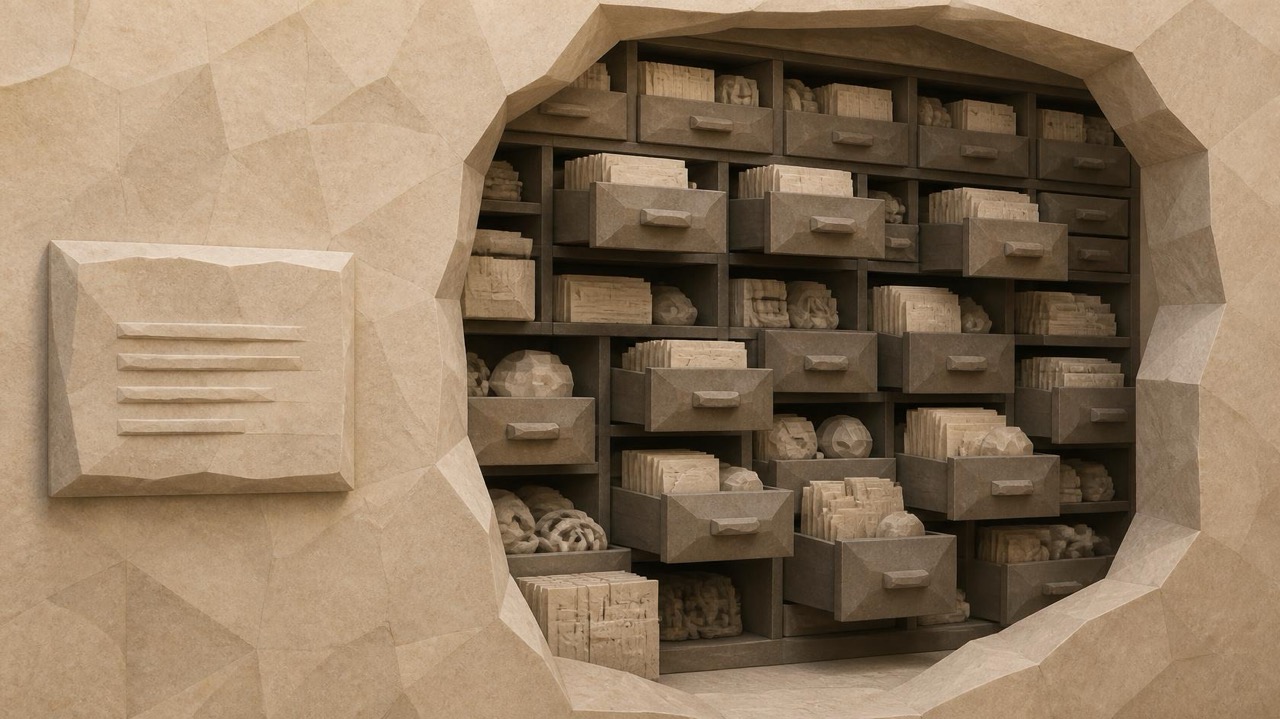
If one searches for a digital work on the website of a major museum, one will find its author, title, date, technique, and, with luck, dimensions. One will not find where its files are located, which file is the master, what software is required, which screen may be substituted, or what licences it employs. That information exists, but it resides in the internal register. And it is that register, which almost no one sees, that decides what is preserved of the work.
What the public record does not disclose
The public records of the Tate, MoMA, or the Guggenheim do not always display the files, their checksums, dependencies, credentials, licences, or spare parts. This is not an oversight: some of this information is technical, some is confidential, and some serves only the conservators. But this has a consequence: from the outside, it is impossible to ascertain how a museum understands a digital work.
In Spain, many museums use DOMUS, the integrated documentation and museum management system developed by the Ministry of Culture. It is based on a standardised model of information structures, procedures and terminology. The public documentation consulted does not make it possible to say that it has a specific module equivalent to the questionnaires, identity reports and iteration reports developed for time-based media. That does not mean DOMUS cannot record components, or that the museums that use it do not create complementary procedures.
A public record is not a conservation file
The public catalogue selects information to identify, contextualise, and disseminate. The internal file must enable the management of the work: provenance, rights, location, condition, files, versions, dependencies, risks, loans, and interventions. Not all of this information should be published. Credentials, locations, values, and technical vulnerabilities require access controls.
The precedent: separating identity and components
The Tate, the Metropolitan, and the Matters in Media Art network have developed a method that separates the identity of the work from its components, its condition, and its successive set-ups. The work has a register, and each file, piece of equipment, copy, and licence has its own, related to it. Thus, when a screen fails, it is known whether it was essential or replaceable.
The limit is that the method needs specialist conservators and that most of the file is internal. A private collection, or a small museum, does not have it to hand.
What a digital collection should register
A useful inventory relates various entities, rather than compressing them into a single row:
- The work, with authorship, title, date, edition, provenance, and rights.
- The components, physical and digital, with their function and whether they can be replaced.
- The files, with format, version, location, and checksum.
- The environment, with software, hardware, accounts, APIs and configuration.
- The iterations, with each installation, migration, or repair.
- The decisions, with date, reason, responsible party, and authorisation.
Spectrum offers collection management procedures, not a software program. It may be applied in digital or paper systems and assists in separating inventory, cataloguing, location, condition, rights, and documentation. For variable media, it needs to be supplemented with specific technical fields and documents.
The register as infrastructure
In my view, the inventory of a digital collection is a good example of an idea I keep defending in this notebook: infrastructures are not limited to storing works; they determine what counts as a work. An inventory that registers a digital work as ‘video, 12 minutes’ treats it as a file. One that registers its components, its margin for change, and its installations treats it as a living system. The choice of register anticipates what can be preserved.
For a private collection, the solution does not require museum software: a well-designed spreadsheet that separates works, components, files, and interventions may suffice, provided it has backups, change control, permissions, and an exportable output. I explain this in the guide on how to inventory a collection with physical and digital works.
About the open conversation
This text separates the data from my interpretation and does not constitute legal advice. If you manage a collection or work in museum documentation and wish to clarify a point or discuss this reading, this notebook remains open: write to me.
The author's relationship with the cases
I hold digital work in my collection, the Esteban-Ruiz Collection, and these issues affect me as a collector. I have no relationship with the museums or the artists mentioned.