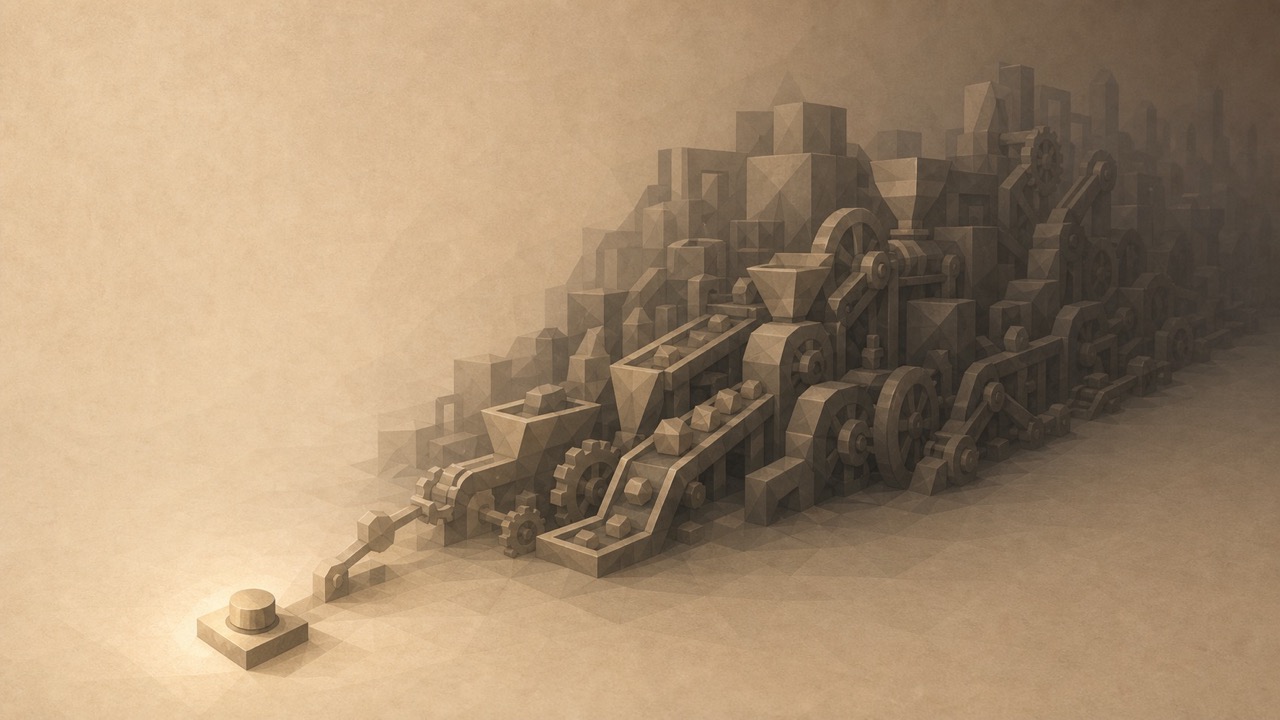
In 1888, a Rochester-based company offered a camera for sale with a slogan that encapsulated something greater than a product: 'You press the button, we do the rest.' The camera was named Kodak, the phrase is attributed to its founder, George Eastman, and those seven words described, without anyone noticing at the time, a new method of manufacturing images that remains intact to this day, up to the moment someone types a sentence into a computer and a machine returns a picture.
What Eastman sold was not merely a smaller camera. It was a division of labour. Until then, taking a photograph required mastery of a difficult chemical process: preparing the plate, sensitising it, developing it, often on the spot and in a portable darkroom. The photographer was, by necessity, a technician. The Kodak dismantled that. It arrived loaded with film for one hundred exposures. The user would point and shoot, and upon finishing the roll, would send the entire camera, the complete box, to the factory. There, workers would develop the film, produce the prints, reload the camera, and return it to the client with the photographs already mounted. The person taking the photograph did not need to know anything about chemistry. Only to press the button.
One must be precise, for the slogan was marketing and exaggerated the truth. It was not literal that one only had to press: one had to cock the shutter, advance the film, and aim with barely a viewfinder. Nor was it mandatory to send it to the factory; those who possessed the knowledge could develop it themselves. It was not the first camera for amateurs, nor did it suddenly place photography within reach of everyone, as it cost a sum that not all possessed. What the Kodak did, and this is indeed historical, was to transform into a mass-market product the notion that one can create an image without mastering the internal mechanics of how it is made. It separated, for millions of people, the gesture of choosing what to photograph from the technique of producing the photograph.
And here lies what led me to this case, a century and more later. Eastman's phrase could be signed today by any artificial intelligence company. You write what you wish to see, you press enter, and the machine does the rest: it composes, illuminates, renders, resolves. It is the same cultural gesture, the same promise. You provide the minimal intention; an invisible infrastructure assumes responsibility for the technical execution. Between the Kodak and the image generator lie one hundred and thirty-seven years and a direct kinship: both conceal a complex chain behind a single-press interface, and both convert that concealment into a product. Convenience is precisely the absence of any requirement to know what occurs inside the box.
Yet there is a difference that must not be erased, one that distinguishes one form of delegation from the other. When Eastman stated 'we do the rest', that 'we' comprised people: laboratory workers, chemists, postal staff, an entire factory of human labour that the interface rendered invisible but not non-existent. Behind the Kodak button, there were people. And, above all, the factory did not decide the photograph. The photographer had already chosen what to frame, from where, at what instant; the machine merely revealed an image that the light and their eye had already fixed. The delegation was of the chemistry, not of the gaze.
In an AI-generated image, however, the delegation is far more extensive. The model does not reveal an image you have already composed; it composes it itself. It determines the lighting you did not request, the texture you did not describe, and the arrangement you did not select. You provide an intention, and a significant portion of the decisions that previously belonged to the photographer—where, how, in what form—are now taken by the system. The black box has ceased to materialise your decision in order to assume an increasing share of it. The 'we do the rest' has gradually consumed the 'you press the button': the user contributes less and less, while the rest becomes ever more.
This is why the history of Kodak is not merely an antiquarian curiosity. It is the first visible link in a chain we continue to traverse: every new imaging technology has expanded what 'the rest' does and reduced what 'you' do. Eastman removed the chemistry and left us with the gaze. Automatic cameras removed the focus and exposure. The mobile phone removed almost all technical decisions. And AI is beginning to remove composition itself, the final element that seemed irreducibly ours. Each step was sold, and purchased, with the same promise from Eastman: do not concern yourself with the difficult parts; we do the rest. The question that none of those campaigns ever asked aloud is what remains of our own work when the rest is already doing almost everything.
About the open conversation
This text begins with a verified fact—the 1888 Kodak camera and its motto, 'You press the button, we do the rest'—to reflect upon the long history of delegating the technical aspects of image creation to an infrastructure, leading up to the prompt of today. I distinguish the fact (the Kodak system, its figures, its limitations) from the interpretation, and I avoid the common exaggerations: that it was the first amateur camera, that it placed photography within everyone's reach, or that the machine 'did the rest' alone, when human labour remained behind it. I also highlight the difference regarding AI: the Kodak revealed an image already decided by the photographer; the generative model decides an increasing portion itself. Should anyone wish to contribute from the perspective of the history of photography, technology studies, or image theory, this notebook remains open.
Sources
US patent US 388,850 ('Camera'), George Eastman, granted on 4 September 1888 (filed on 30 March 1888). The Kodak camera went on sale in 1888; the Kodak trademark was a separate registration (no. 15,825).
The slogan 'You press the button, we do the rest', attributed to Eastman, associated with the 1888 launch; advertisement dated November 1889.
The system (camera loaded for 100 exposures, $25; returned to Rochester for $10 for developing, printing, mounting and reloading): Smithsonian (Original Kodak Camera) and Metropolitan Museum of Art. The 1888 material was paper negative; transparent celluloid arrived in 1889.
Context: American Chemical Society and George Eastman Museum. Broader economic democratisation arrived with the Brownie (1900).