
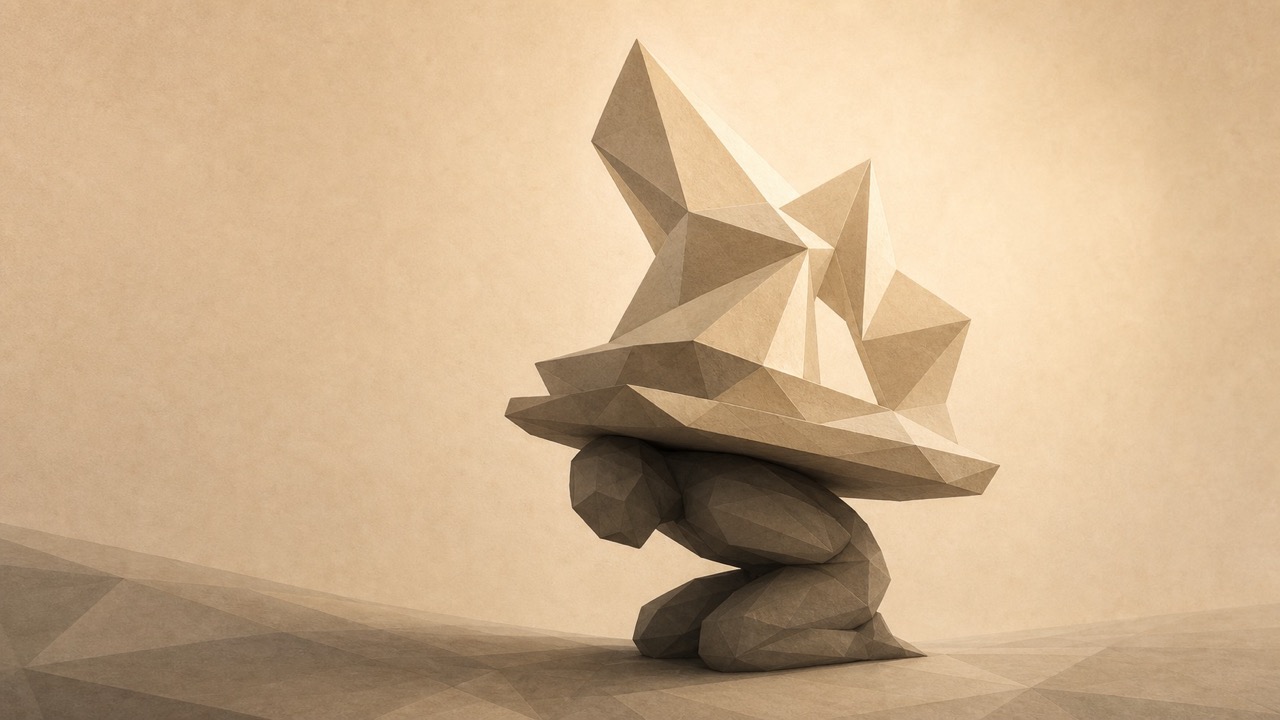
At the 2024 Venice Biennale, the Holy See pavilion was installed within a women's prison. The inmates guided the tours and signed some of the texts. At the 2026 Malta Biennale, nine prisoners from Corradino exhibited their work in a historic armoury. An Italian foundation takes the work of over two hundred artists living in refugee camps across Europe, even to the European Parliament. In parallel, another Venetian pavilion brought together persecuted and exiled artists from Sudan, Syria, Ukraine, and Afghanistan. The major art circuits have incorporated a new material: the experience of those who are not free.
I use the term 'material' deliberately. In many of these projects, the vulnerability of the creator is not the subject of the work; it is its condition of possibility. Without the prison, without the camp, without the exile, there would be no pavilion. The author's extreme circumstance does not appear within the work as a subject; it operates beneath it, as that which renders the hosting institution visible and valuable. The question is not whether this is inherently right or wrong, but what separates two things that appear similar yet are not the same: giving a voice to those who lack one, and instrumentalising their lack of freedom to legitimise those who exhibit them.
In Malta, some of the prisoners who exhibited received job offers upon their release. The pavilion for artists at risk relies on a network that has relocated over eight hundred persecuted creators. In the Venice prison, one inmate described the experience as a crack of beauty within the monotony; they occupied the role of mediators, not merely objects to be observed. The foundation for refugee camps attributes each work to its author by name; it does not dissolve the victims into an anonymous mass. Providing space, attributing authorship, opening a professional door: these are tangible benefits. Those who deny these elements to focus solely on suspicion are as dishonest as those who celebrate without scrutiny.
The issue is not that this work is being exhibited. It lies in what remains unsaid. In three of the four cases I have reviewed, the most basic data is not public: whether the participants were paid, whether they ceded rights to their image and words, whether they could refuse without consequences, and who decided what was shown and how. Inclusion, the gesture, and the photograph of the encounter are made public, while silence is maintained regarding the distribution of the value that this encounter produces. The institution gains prestige, coverage, visitors, and in one case, a papal visit. The professionals who install, curate, and mediate are paid for their work. Regarding what those who provide the experience that legitimises the entire edifice receive, we know almost nothing. This silence is not an administrative detail: it is precisely the information that would allow one to distinguish collaboration from exploitation.
Claire Bishop studied participatory art with greater lucidity than anyone else. She left behind an observation that avoids simplification: instrumentalisation is not inherently wrong, and many fine artists place their role at the service of valuable social ends. The problem arises when participation is used as a symbolic solution to a problem that remains intact. Exhibiting inmates does not change the conditions of the prison. Showing the art of a refugee camp does not alter the policy that maintains the camp. When visibility replaces material advocacy, rather than accompanying it, inclusion becomes an image that the institution consumes to enhance its own reputation.
Calling someone 'vulnerable' is not merely a description: it is the construction of the category by which that person becomes selectable. In a circuit that must constantly renew its narrative, vulnerability becomes a curatorial quality, that which makes an author interesting for the programme. The risk is inverted: it is no longer the work that paves the way for its author; it is the author's dramatic circumstance that gives value to the work. Recognition falls upon the wound, not upon what the person is capable of doing. They are viewed for what they lack, not for what they contribute.
The difference between giving a voice and instrumentalising is not decided by the stated intention, which is always well-meaning, but by what the institution makes public. Can the participant refuse without cost? Do they sign with their own name? Do they control the use of their image? Are they paid, beyond receiving workshops or 'visibility'? Do they decide anything regarding how their story is told? Does any lasting benefit remain for them from all this, or only for the prestige of the host? When those answers are made public, there is collaboration. When they are replaced by a photograph of the encounter, what remains exposed is not the work: it is the distance between the one who signs it and the one who sustains it.
About the open conversation
This text examines a trend within major art circuits: incorporating the work of imprisoned, refugee, or persecuted individuals. I do not arbitrate specific cases nor do I accuse institutions for which I lack contractual information, which is almost never public, and that silence is part of what I am highlighting. I am interested in the criteria that separate giving voice from using vulnerability as a credential. I take verified facts as true and distinguish what is documented from what is not established. If anyone wishes to intervene from the perspective of curatorship, social work, refugee studies, practice in confinement contexts, or personal experience, this notebook remains open.
Sources
Holy See Pavilion, Con i miei occhi, 60th Venice Biennale, at the Giudecca women's prison (20 April – 24 November 2024). Coverage and critique: Artnet News (Naomi Rea).
Malta Biennale 2026, Floating Fragments, with nine inmates from Corradino; testimonies and subsequent job offers collected by Television Malta (TVM).
Imago Mundi, Out of Place. Art and Stories from the World’s Refugee Camps (travelling exhibition 2024–2026, including a visit to the European Parliament).
Artists. Risks. Humans. Rights, Artists at Risk / Perpetuum Mobile with the support of UNESCO, Palazzo Zorzi, Venice (17 April – 16 May 2024).
Bishop, Claire. Artificial Hells: Participatory Art and the Politics of Spectatorship. Verso, 2012 (ch. 'Delegated Performance: Outsourcing Authenticity').
On the category of vulnerability: Cathrine Brun (2025). Related frameworks: Grant Kester (dialogical aesthetics) and T. J. Demos, The Migrant Image (Duke University Press, 2013).