
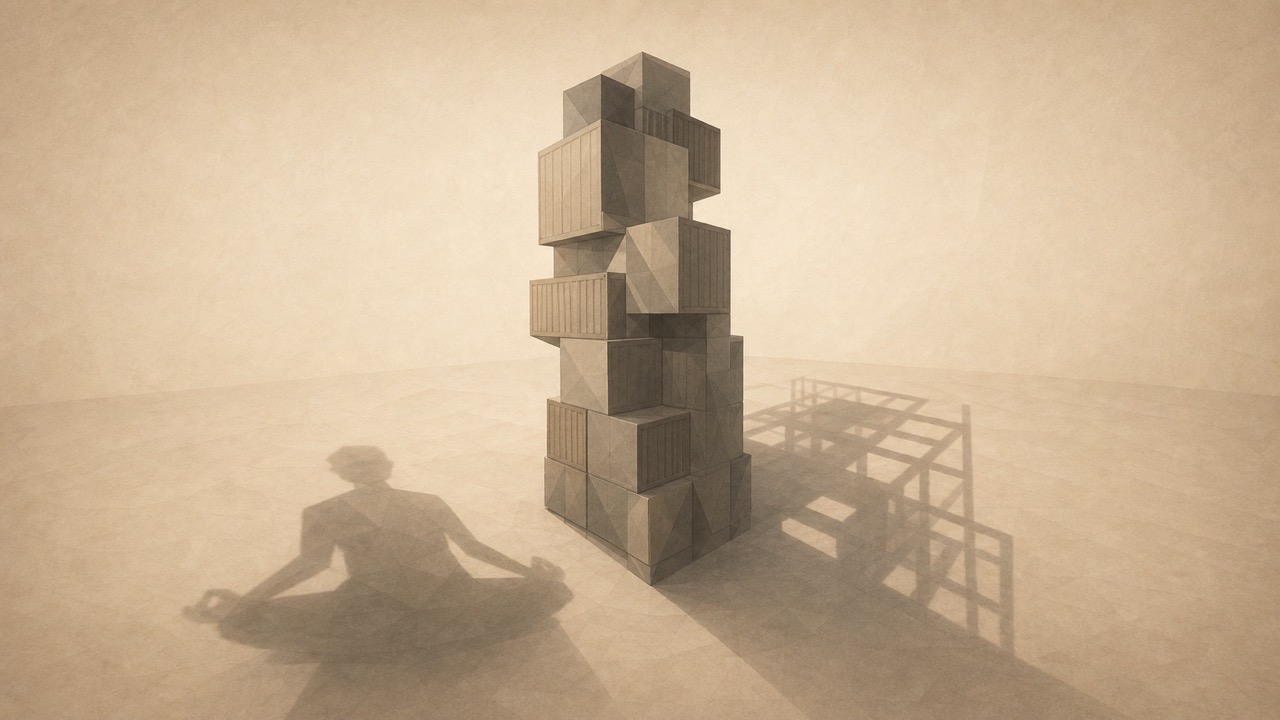
In a field in Montauk, a seated figure in the lotus position stands nearly eighteen metres tall, constructed from twelve shipping containers that traversed the ocean for years before their retirement. Titled Meditating Figure, the work is by Matt Johnson and has been part of an open-air exhibition since the end of June. To the art world, it is a monumental sculpture; to the East Hampton Town Council, it is a structure lacking a building permit. Both assertions are simultaneously true, and that overlap constitutes the core of the matter.
El municipio no ha dicho que la pieza sea mala, ni ofensiva, ni que no merezca exhibirse. No ha juzgado la obra en cuanto obra. Ha hecho algo distinto: la ha reclasificado. El abogado del pueblo lo formuló con una claridad que vale la pena citar: «Por definición, esto es una estructura: están soldando grandes piezas de metal. Tiene que pasar por el departamento de edificación para las comprobaciones de seguridad aplicables». Los cargos son de manual urbanístico: falta de licencia de obra, falta de certificado de ocupación, falta de aprobación del comité de revisión arquitectónica y afectación de un suelo con protección agrícola.
Viewed through the lens of the building code, the argument is impeccable. An eighteen-metre construction of welded steel through which the public will walk is precisely the type of object that inspection exists to review. That it is a sculpture does not render it more stable. And New York law, according to the council itself, makes no distinction: if something qualifies as a structure, it requires a permit, and the municipal code contains no exception for art.
Leído desde el mundo del arte, el argumento es igual de sólido y dice lo contrario. Es una obra, está firmada, está expuesta; la reconoce el campo que reconoce obras. El único concejal que votó en contra de emprender acciones lo dijo sin rodeos: «Es una obra de arte pública. No tenemos muchas pautas sobre cuándo estamos restringiendo la exhibición de arte. Negar a la gente la posibilidad de exponer arte no es algo que yo apoye».
The striking aspect is not that one of the two parties is mistaken, but that neither is. The solicitor sees welding; the councillor sees art. They observe the same object and both are correct, because they are observing from distinct regimes, and each regime brings its own category, its own rules, and its own criteria for what counts. This is not a clash between those who are right and those who are wrong. It is a clash between two systems that recognise different things in the same fragment of the world.
This connects with a premise I maintain in the research on recognition that I am developing with Adolfo Cortés García: the status of a work is not a property that the object carries, switched on or off, but something that depends on the system evaluating it. A single object may carry a surplus that one regime recognises and another does not register at all. This is not because one is correct and the other is mistaken, but because each system is calibrated to perceive its own domain. The building code lacks a sensor for art, just as the art world lacks one for wind load on a piece of steel. Each is blind precisely to what the other sees.
Therefore, this case is not a narrative of bureaucracy versus creativity, although it may be recounted as such and indeed is. A sculpture does not cease to be art simply because the local council designates it a structure. It remains art to all those who recognise it as such, and they are many. What occurs is that it has also entered a second regime for which its status as a work of art is simply irrelevant: it does not deny it, it does not dispute it, it does not perceive it. Under the building code, whether it is an eighteen-metre meditation or a water tank is immaterial; what matters is whether it is structurally sound and possesses the requisite documentation.
And here lies the aspect that an artist notices before a jurist. An object does not possess a single status. It possesses as many as the regimes that interact with it. The same seated figure is a work in the gallery, a structure in the building department, an asset on a balance sheet, merchandise at a fair, and perhaps an obstruction to a neighbour. None of these statuses is the 'true' one with the others merely being ornamental. They coexist, and most of the time they do not interfere because they operate on planes that do not intersect. They interfere when, as in this instance, two of them claim the same object simultaneously with incompatible consequences: one desires it to remain, the other that it undergo the procedure or be removed.
Lo que el conflicto de Montauk deja ver, y por eso me parece más que una anécdota veraniega de los Hamptons, es que no existe un lugar neutral desde el cual decir qué es «realmente» esa escultura. El punto de vista del arte no es más verdadero que el del código, ni al revés. Son dos formas de aprehender el objeto, cada una completa dentro de sus reglas y ciega fuera de ellas. Preguntar cuál tiene razón es como preguntar si un acorde es «realmente» una vibración del aire o una emoción: las dos cosas, según quién escuche.
The judge presiding over the case in September will not resolve that question, as it lies beyond their purview. They will decide upon something more modest and concrete: whether, for the purposes of the New York building code, this sculpture requires a permit. They will determine the status of the documentation. What the work itself is will continue to depend, as it always has, upon who is viewing it and through which regime.
About the open conversation
This text applies to a recent case an idea I am developing in my research on recognition, which I share with Adolfo Cortés García: that the status of a work is not an inherent property of the object, but rather something relative to the system evaluating it, such that distinct regimes may recognise different things in the same object without either being mistaken. The Montauk case demonstrates this with rare clarity, as two regimes lay claim to the same sculpture simultaneously. Should anyone wish to intervene from the fields of urban planning law, cultural management, museology, or art theory, this notebook remains open.
Sources
The Art Newspaper, 13 August 2026 (statements by Patrick Derenze and Jake Turner; description of the work and the site).
The East Hampton Star, 6 August 2026 (citations from the complaint; location and description).
Urgent Matter, 3 and 13 July and August 2026 (procedural chronology: complaint of 28 July, TRO of 31 July, hearing of 9 September; distinction between lawsuit and administrative charges).
The Ranch, official page of LA Monumental (exhibition framework and dates).
East Hampton Town Code, §102-7 (building permit) and §102-14 (certificate of occupancy).
Cortés García, Adolfo, and Juan A. Esteban Ruiz. Recognition and Surplus. Zenodo, 2026. https://doi.org/10.5281/zenodo.21630455