
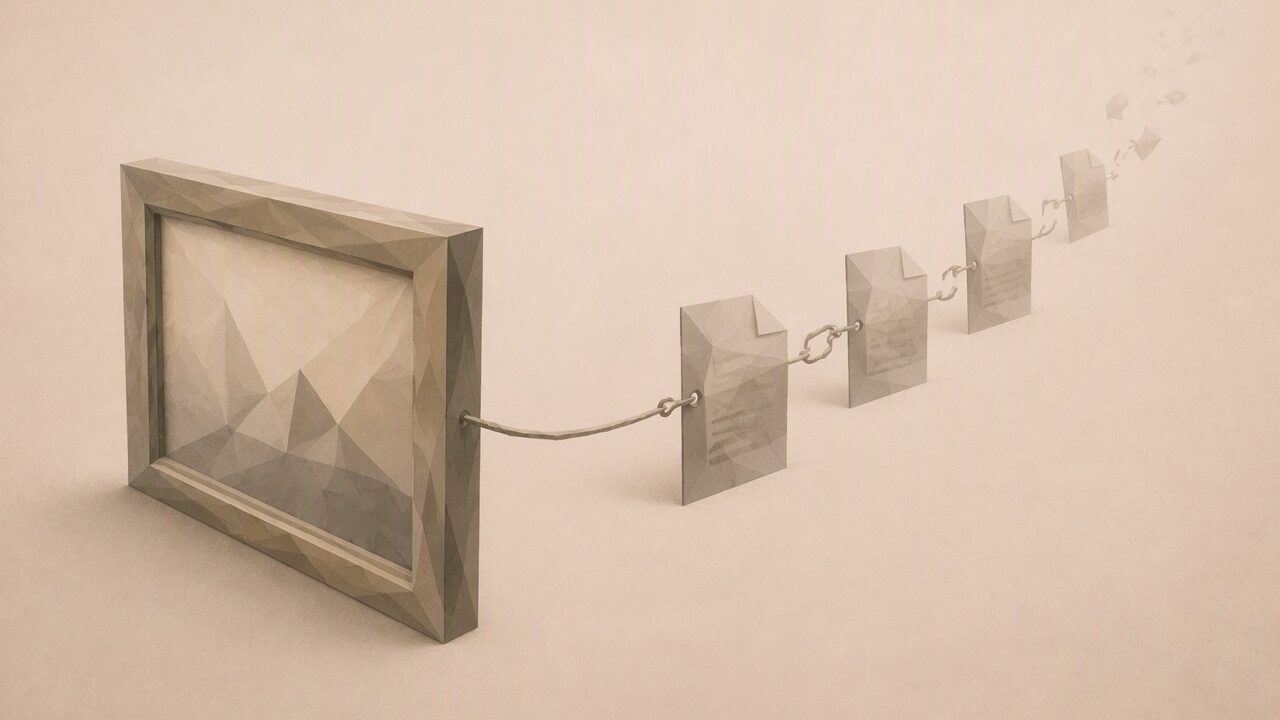
A painting from four centuries ago has been relined, its varnishes removed and replaced, its frame changed several times, its cracks stabilised, and certain areas repainted by hands other than those of the author. If one were to count the atoms, perhaps very little of the material that left the original studio would remain.
We call it authentic, we insure it as authentic, we hang it under its name. No one who defends it would claim it is a different object. This, which we take for granted, conceals a question: if the material has changed so much, in what exactly does its authenticity reside? It is clear that physical permanence does not sustain it. The work has gradually lost and replaced its body, much like the Ship of Theseus whose planks are replaced one by one, and yet we continue to assert that it is the same vessel. That which certifies its identity must lie elsewhere.
Está en una cadena. No en el objeto, sino en la continuidad documentada de reconocimientos que decidimos creer: quién la hizo, por dónde pasó, quién la atribuyó, qué manos la cuidaron, qué papeles lo acreditan. La autenticidad de una obra no es una propiedad que se pueda tocar; es una relación sostenida en el tiempo entre la pieza y un tejido de testimonios. Cuando compramos «una obra auténtica», compramos sobre todo la solidez de esa cadena.
A perfect forgery could be, materially, superior to the original: better preserved, more intact, perhaps even more beautiful. And yet we reject it as the work of another, and rightly so. What concerns us is not the quality of the material before us, but whether that material is linked to the true chain. We prefer the damaged and mended original to the impeccable forgery. This demonstrates, better than any argument, that authenticity is not a quality of the object: it is a bond with a history, and that bond may or may not exist regardless of the piece's appearance.
Nelson Goodman lo formuló con precisión hace décadas al distinguir las artes autográficas de las alográficas: en la pintura, a diferencia de la música, la distinción entre original y copia es constitutiva, porque la obra está atada a la historia concreta de su producción. Walter Benjamin había señalado antes esa atadura al hablar del «aquí y ahora» de la pieza, su existencia en un lugar y un tiempo únicos. No leerlo como una nostalgia: Benjamin no defendía el aura, diagnosticaba su fractura y anticipaba lo que vendría después. Pero su descripción sirve para lo que aquí importa: que la identidad de una obra plástica está enganchada a una trayectoria irrepetible, no a lo que se ve en ella.
If authenticity is sustained by a chain of recognition and documentation, then it is only as solid as that chain, and chains break. A lost opinion, an interrupted provenance, a testimony that cannot be verified: each broken link does not damage the material of the work, but it weakens its demonstrable authenticity, which for all practical purposes is much the same. Hence, the art market is so vulnerable in this regard, and so dependent upon paperwork: not because the documents are the work, but because they are the only means of keeping the bond visible when living memory fades.
That demonstrable authenticity depends upon a chain does not mean that what the work does depends upon it. Before a painting, what occurs — if it arrests us, if it opens something — does not consult its certificate. One may lose all documentation for a piece and still have before them exactly what moved them yesterday; what is lost is not the experience, but the possibility of proving it to others, of insuring it, of selling it. The chain does not sustain the encounter with the work. It sustains its circulation in the world, which is a different matter, and one that also carries weight.
A certificate, whatever its form, never guarantees that which would be most worth guaranteeing. It protects the transaction, not the discovery; the heritage, not the gaze. It renders an identity demonstrable to third parties that the work, in its silent presence, already possessed without the need for proof. And perhaps there is something almost consoling in this: that the most valuable aspect of a work is, precisely, the only thing that no documentary chain can certify. Not a trait that can be archived, but something the work continues to be capable of, whether or not someone is present, and which occurs again, anew and without witnesses, each time someone pauses to look at it.
About the open conversation
This text belongs to my series on the ontology of the work: what constitutes it beyond its material, and how authenticity, far from being a property of the object, is sustained by a chain of documented recognition. I intentionally distinguish between demonstrable authenticity—which requires such a chain—and what the work performs before the viewer, which requires no certificate whatsoever. Should anyone wish to contribute from the perspectives of philosophy of art, conservation, the law of authenticity, or market practice, this notebook remains open.
Sources
Goodman, Nelson. Languages of Art: An Approach to a Theory of Symbols. Indianapolis: Bobbs-Merrill, 1968. (Distinction between autographic and allographic arts.)
Benjamin, Walter. “The Work of Art in the Age of Mechanical Reproduction” (1935-1936). In Illuminations, London: Fontana.
Plutarch. Parallel Lives, “Theseus” (Ship of Theseus paradox).
Cortés García, Adolfo, and Juan A. Esteban Ruiz. Recognition and Surplus: On the Double Dissociation between Structural Surplus and Historical Recognition, and Its Compression under Algorithmic Mediation. Zenodo, 2026. https://doi.org/10.5281/zenodo.21630455