
On why the critique of contemporary art is played out in the infrastructure and not in the message
There is a widely held, and very comfortable, idea about what makes art political: that it is so because of its subject matter. A work is considered political if it denounces, if it represents a conflict, if it takes a side, if it carries a message. Under this logic, calling for 'more political critique' in contemporary art is equivalent to calling for more committed works and more readings that measure works by their cause. I wish to defend the opposite: that this idea of the political is the weakest of those available, and that a truly political critique of art has long since stopped looking at the content of works to look at something else.
The curious thing is that I did not discover this by thinking it through myself. Art itself discovered it, half a century ago, and it has a name.
1. What institutional critique already knew
At the end of the nineteen-sixties, a practice appeared that historiography calls institutional critique. Artists stopped asking themselves what to represent and began to ask themselves where it is represented, who pays for it, who decides what enters the museum, and what social function the institution that hosts them fulfils. The gesture was a displacement, and it is worth naming it with precision: the politics of art moved from the represented content towards the material and institutional conditions of production, exhibition, and legitimation.
Benjamin Buchloh described that trajectory as a step from an 'aesthetics of administration' towards a critique of institutions. Andrea Fraser, years later, provided the most honest twist: institutional critique ended up becoming institutionalised, to the point of becoming an object of exhibitions, symposia, and art history itself. From the critique of the institution, it moved to an institution of critique.
That drift, which many read as a defeat—the institution swallows those who criticise it—actually contains the lesson that interests me. If criticising the institution from within ends up being absorbed by the institution, it is because the political nature of art was never in a position of pure exteriority, in a message launched against power from the outside. It was in the structure itself. And the structure is difficult to criticise precisely because one always speaks from within it.
2. The false dilemma: politics versus curating
This is where it is worth dismantling an opposition that is often heard: that contemporary art needs more political critique and less curatorial critique, as if one thing competed with the other. They do not compete, and framing it this way confuses two distinct levels.
Art criticism, in the classical sense, produces judgement: it interprets, evaluates, and argues in public why a work matters. Curating produces something else: it selects, mounts, mediates, and manufactures the conditions in which a work is received. These are different functions. But there is a point where they are indeed comparable, and it is decisive: both are forms of cultural authority. Both order visibility, both decide what is seen and how, both distribute value.
And if the political nature of art is played out in the conditions of appearance—who selects, who finances, who mediates, who remains inside and who outside—then it turns out that these questions are, literally, curatorial and institutional questions. Curatorial critique, when well understood, is not a frivolous alternative to political critique. It is the adult form of political critique. The error is not in performing curatorial critique: it is in performing it without noticing that every selection, every montage, every mediation programme is already a political decision regarding the distribution of the visible.
In other words: contemporary art does not need to choose between the political and the curatorial. It needs a critique that understands that curatorship is where the political occurs.
3. Why “political art” of the message is the impoverished version
If this is so, the idea of the political as content—art that denounces, activist art, the message-work—is not the strong version of political critique. It is the weak one. And there are good reasons, not just intuitions, to maintain this.
Claire Bishop argued this harshly regarding participatory art, that family of practices which during the nineties was presented as political art par excellence, for promoting collaboration, inclusion, and social bonds. Bishop objected that evaluating these works by ethical criteria—whether they collaborate, whether they include, whether they do good—replaces artistic judgement with a kind of moral verification. A work ceases to be judged by what it opens up, by its form, by its capacity to discomfort, and starts to be judged by the declared goodness of its cause. The result, she warns, is a softer art, not a more political one: easier to applaud and less capable of questioning anything.
The fundamental problem with message-art is that it confuses having a political subject with producing a political effect. A work can represent a conflict and leave all conditions intact—the museum that exhibits it with money from those who provoke that conflict, the circuit that turns it into a prestigious commodity, the public that leaves moved and remains the same. The content denounces; the infrastructure absolves. That is why a critique that only looks at the content remains on the surface of the problem it believes it is attacking.
4. The counterpoint that should not be overlooked
Up to this point, it might seem sufficient to shift everything towards infrastructure: that the politics of art is a matter of who provides the funding and who makes the selection, and that the work itself is almost a pretext. This would be a convenient, and, I believe, false conclusion. There is a serious objection to the contrary, and an honest text must sustain it, not evade it.
Adorno argued that art retains its critical power not when it becomes a direct political instrument, but precisely when it does not: through its form, its negativity, and its resistance to immediate communication. Art that surrenders entirely to its function—even a critical function—loses what enabled it to resist. More recently, Nicholas Brown has argued that attention to form can suspend the logic of the commodity, that art has not collapsed entirely into a pure market object, and that this formal autonomy is what still allows a work to signify something not reducible to its price or its cause.
I take that objection seriously because it corrects the excess of my own argument. If we were to reduce everything to infrastructure, art would dissolve into its sociology: nothing would remain of the work except the conditions surrounding it. And that is as impoverishing as the art-as-message I criticise, only from the other side. There is a formal remainder in the work that refuses to be instrumentalised, even by the most sophisticated infrastructural critique. A remainder that is not the subject, nor the cause, nor the institutional position: it is what the work does when someone stands before it and something is reorganised. That is not decided by the sponsor or the curator.
5. What critique is needed, then
The conclusion is not “more politics, less curating”. It is a two-handed critique.
With one hand, it reads the infrastructure without naivety: it asks who funds the exhibition, what interests the sponsorship sanitises, whom the curator selects and whom they exclude, what the installation makes visible and what it buries, and how the circuit converts a protest into a prestigious asset. This is mature political critique, and it is inseparably curatorial. To look at the painting and ignore the wall, the money, and the hand that selected it is to perform art criticism as if the work were floating in a vacuum.
With the other, it does not dissolve the work into those conditions. It maintains that, after having read the entire infrastructure, something remains that the infrastructure does not explain: the form, what it opens up, the remainder that does not surrender to any function. A critique that possessed only the first hand would be sociology; one that possessed only the second would be formalism blind to power. It is necessary to sustain both simultaneously, which is the difficult part.
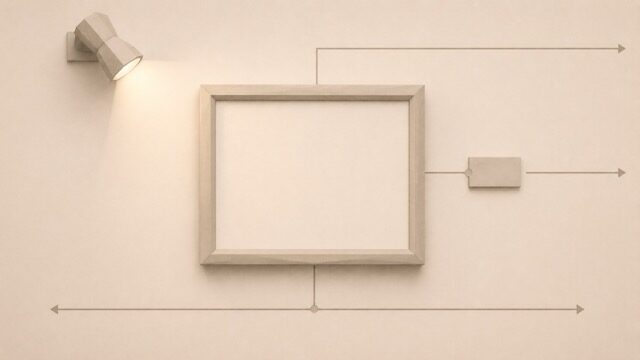
The politics of contemporary art, therefore, does not reside in the painting. It resides on the wall, on the label, in who pays for the light that illuminates it, and in who decided to hang it there instead of another. Recognising this does not diminish the work: it liberates it from a demand that was never its own—that of bearing alone, in its subject matter, a political weight that is actually distributed throughout the entire system surrounding it. And by lightening it of that burden, space remains for what the work can indeed do and what nothing else can do for it: to reorganise, for a moment, the way we look. That part is not signed by any sponsor. It remains, fortunately, a matter between the work and the person who pauses before it.
On open conversation
This text continues the reflection on infrastructure, validation, and recognition that runs through this Notebook, and brings to the field of criticism the shift from content towards infrastructure that I explore in my research. If anyone wishes to intervene from the perspective of curating, art criticism, institutional theory, or cultural management practice, the notebook remains open.
Sources
Alberro, Alexander; Stimson, Blake (eds.) (2009). Institutional Critique: An Anthology of Artists’ Writings. MIT Press.
Fraser, Andrea (2005). “From the Critique of Institutions to an Institution of Critique.” Artforum, 44(1), 278-283.
Buchloh, Benjamin H. D. (1990). “Conceptual Art 1962–1969: From the Aesthetic of Administration to the Critique of Institutions.” October, 55, 105-143.
O’Neill, Paul (2012). The Culture of Curating and the Curating of Culture(s). MIT Press.
Martinon, Jean-Paul (ed.) (2013). The Curatorial: A Philosophy of Curating. Bloomsbury Academic.
Rogoff, Irit (2008). “Turning.” e-flux journal, 0. https://www.e-flux.com/journal/00/68470/turning/
“Round Table: The Present Conditions of Art Criticism” (2002). October, 100, 200-228. https://doi.org/10.1162/016228702320218475
Elkins, James (2003). What Happened to Art Criticism?. Prickly Paradigm Press.
Bishop, Claire (2012). Artificial Hells: Participatory Art and the Politics of Spectatorship. Verso.
Kester, Grant H. (2004). Conversation Pieces: Community and Communication in Modern Art. University of California Press.
Rancière, Jacques (2004). The Politics of Aesthetics: The Distribution of the Sensible. Continuum.
Groys, Boris (2008). Art Power. MIT Press. https://doi.org/10.7551/mitpress/7469.001.0001
Adorno, Theodor W. (1997). Aesthetic Theory. University of Minnesota Press.
Brown, Nicholas (2019). Autonomy: The Social Ontology of Art under Capitalism. Duke University Press. https://doi.org/10.1215/9781478002673